Micro-blogging is the practice of sending brief posts to a personal blog on a micro-blogging Web site, such as Twitter or Jaiku. Micro-posts can be made public on a Web site and/or distributed to a private group of subscribers. Subscribers can read micro-blog posts online or request that updates be delivered in real time to their desktop as an instant message or sent to a mobile device as an SMS text message.
A new idea for Micro blogging has been to turn it into a way to talk to other people about work. It allows a person to give quick news or information to the people they work without sending a lot of emails and without the spam they get in their email account. New companies such as Yammer have been started who want to help allow workers to talk to each other with about work and share what they need.
What is Micro-blogging ?
Social Media for Learning
Following on from my previous post where I discussed the need for spelling out the use of social media for learning, I have now pulled together a new resource, which looks at how social media can be used for different types of learning.
You can categorise the use of social media in the following 5 different ways:
1.IOL - Intra-Organisational Learning - how social media tools can be used to keep employees up to date and up to speed on strategic and other internal initiatives
2.FSL - Formal Structured Learning - how educators (teachers, trainers, learning designers) as well as students can use social media within education and training - for courses, classes, workshops etc
3.GDL - Group Directed Learning - how groups of individuals - teams, projects, study groups etc - can use social media to work and learn together (a "group" could just be two people, so coaching and mentoring falls into this category)
4.PDL - Personal Directed Learning - how individuals can use social media for their own (self-directed) personal or professional learning
5.ASL - Accidental & Serendipitous Learning - how individuals, by using social media, can learn without consciously realising it (aka incidental or random learning)
All you need to do now, is to decide which type of learnings you or your organisation want to support/enable - and how.
OODA
Although originally developed for fighter pilots and then adapted by the Armed Forces, Boyd's OODA Loop (Osinga, 2007) is now used by organizations as a decision-making tool that a person or team cycles through as rapidly as possible to help them to stay ahead of their competitors.

Observe
In this part of the action loop the observer scans the environment in order to gather information and learn about it. However, in this day of abundant information, think more of applying the right filters to gather the information that will be most useful to you. As Clay Shirky notes, “It's Not Information Overload. It's Filter Failure:”Organizations can help their workers by setting up master portals of relevant links and feeds for each of their various workgroups, and then using a learning platform to help the workers to select the ones that pertain to them the most so they can build their own personal learning environment (PLE) for scanning their environment.
Another useful tool is the ones that belong in the microblogging category, such as Twitter or Yammer, that not only allows our network to send us relevant information and vice-versa, but also allows us to ask for help when we are trying to find information. This may also require a learning platform that will help the workers to learn to send useful information without flooding their coworkers with useless information.
In addition, organizational blogs allow the workers to easily publish their observations so that others may benefit from them. An added benefit is that the readers can provide comments so that the observer/writer receives feedback as discussed in the next part of the action loop — Orient.
Orient
The second part of the action loop is synthesizing the data and information gathered during "observing" into a mental image of the circumstances. As more information is received, you "deconstruct" old images and "create" new images. Within this part of the action loop you have to question past beliefs to see if they still hold true when compared to the new information.This is perhaps the hardest part of the four actions because we basically fail to ask the right questions and to question our beliefs. For example, Chris Argyris discovered that even highly educated adults stick with Single-Loop Learning rather than using Double-Loop Learning by questioning underlying assumptions:

Boyd also noticed this phenomenon in that he spent most of his time emphasizing orient in the OODA loop.
The learning profession also shows this trait of failing to orient themselves in that they rush through the analysis part of a project so fast they fail to properly align the learning platform with real business needs. Secondly, they fail to scan the environment far enough ahead, so rather than designing learning processes, they end up with a learning event that fails to transfer to the workplace. And finally, they fail to evaluate their original beliefs, thus rather than capturing lessons learned, they are doomed to a cycle of repeating their mistakes. No wonder we always hear the old mantra, “ADDIE must die!” — we would rather rush ahead with ill-designed rapid development programs that simply concentrate on development and delivery, rather than properly orientating ourselves to the present environment.
Not only do we fail to question our beliefs, but when we ask others for feedback, they normally evaluate before trying to fully understand. Carl Rogers discovered five main categories of feedback. They are listed below in the order in which they occur most frequently in daily conversations:
- Evaluative: Making a judgment about the worth, goodness, or appropriateness of the other person's statement.
- Interpretive: Paraphrasing - attempting to explain what the other person's statement means.
- Supportive: Attempting to assist or bolster the other communicator.
- Probing: Attempting to gain additional information, continue the discussion, or clarify a point.
- Understanding: Attempting to discover completely what the other communicator means by her statements.
Thus a formal learning strategy is needed to help the workers develop skills that allow them to question their beliefs and asking probing questions to see if their beliefs are still valid. In addition, this needs to stretch in the other direction so that when others ask for our opinions, we use the five categories of feedback in the proper direction — we gain a level of understanding by using probing, supportive, and interpretive feedback before we provide an evaluation.
Secondly, the microblogging tools mentioned in the Observing portion of the Action Loop can be used just as effective, if not more, to get the a broader range of opinions from others.
In addition, the use of wikis or other social editing tools, allow teams performing the OODA Loop to rapidly edit group documents as they reorient themselves.
Decide
The use of PLEs with RSS feeds, blogs, microblogging tools, and wikis in the OODA loop allows the workers to consider all the options and select a subsequent course of action.Act
This is where you carry out the conceived decision. Once the result of the action is observed, you start over. However, before you do, capture lessons learned by using an AAR so that learning becomes part of the natural process:
Loop
Note that in combat or when competing against your competitors, you want to cycle through the four action steps faster and better than the enemy, hence, it is a loop. Also, you do not select an action because it is the most effective, but rather an action that your competitor or enemy is least expecting (Corma, 2004).Capturing Lessons Learned with an AAR
This method uses a three-prong process:
- Capture the Lessons Learned
- Store it in a social site for easy retrieval
- Provide a microblogging tool to help others to learn about recent lessons learned.
- Classroom — Having the learners discovering which of their projects will make good candidates for running through an AAR.
- eLearning — Once their projects are nearing their completion, they receive some just-in-time training for:
- Questioning Techniques — Use scenarios, for example, rather than asking, “Robert, why did your equipment operators remove the safety guards from the equipment?,” they select, “Robert, can you tell us about your recent safety inspection?”
- Using the four basic steps of an AAR:
- Capturing the results of the four steps through mind maps that keep the steps aligned and use a visual mode that allows other learners to more easily understand them.

Creating Informal Learning Environments

Complex learning environments are normally composed of a lot of informal learning as all this learning taking place would be quite inefficient if placed in a formal learning platform. This means that you must not only support the formal learning though faster and smaller learning chunks, but also support the ever increasing informal learning.
One there are many ways of going about this, this section will discuss two strategies for supporting informal learning,1) through lessons learned and 2) the OODA Loop.
Click on them to learn more -
2.OODA
3.Social media
4.Microblogging, etc.
Characteristics of Formal and Informal Learning Episodes
Allen Tough, a Professor Emeritus at the University of Toronto, focused his research on the adult's successful efforts to learn and change; and in particular the 70% that are self-guided without relying much on professionals or institutions (informal learning). During his research, he discovered that people spend an average of 15 hours per week learning on their own (Tough, 1999).
In the late 1970s, Patrick Penland, a library school professor at the University of Pittsburgh, became quite interested in Tough's research. He performed a survey in which a section of it pertains to why learners prefer to learn on their own, rather than in a class or course (Penland, 1977). The main reasons, in ranking order, are:
- Desire to set my own learning pace.
- Desire to use my own style of learning.
- I wanted to keep the learning strategy flexible and easy to change.
- Desire to put my own structure on the learning project.
- I didn't know of any class that taught what I wanted to know.
- I wanted to learn this right away and couldn't wait until a class might start.
- Lack of time to engage in a group learning program.
- I don't like a formal classroom situation with a teacher.
- I don't have enough money for a course or class.
- Transportation to a class is too hard or expensive.
What is interesting about the survey is that for the most part, it is not that learners lack resources or hate attending formal classes, for these items are at the bottom of the rankings, but rather they prefer being in charge of their own learning.
In addition, the top items in the rankings show that while learners prefer to take charge of their own learning, it does not mean that they enjoy solitary learning. Tough (1999) discovered that within each informal learning episode (where the primary motivation is to gain and retain certain knowledge and skill on a task or thing), the average learner interacts with an average of 10 people. In fact, there may actually be more social interactions during informal learning episodes than there are in classrooms. Thus, we begin to get a picture of why blended learning became the next step in the elearning evolutionary process.
While the last two items pertain to a lack of resources, the first eight items show a desire to take charge (learner control) of one's own learning episodes. These eight "design" characteristics control or impact most learning episodes:
- Desire to set my own learning pace = self-pace.
- Desire to use my own style of learning = personalized.
- I wanted to keep the learning strategy flexible and easy to change = tactical.
- Desire to put my own structure on the learning project = empowerment.
- I didn't know of any class that taught what I wanted to know = complex.
- I wanted to learn this right away and couldn't wait until a class might start = just-in-time.
- Lack of time to engage in a group learning program = flexibility
- I don't like a formal classroom situation with a teacher = casual
The chart below shows each learner control characteristic that leads to informal learning and its opposite — the corresponding designer control characteristic that leads to formal learning.

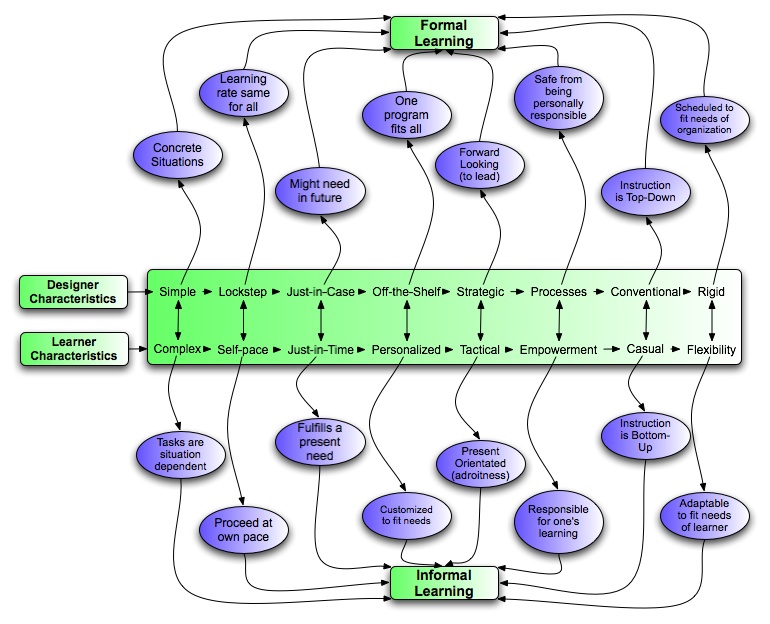
Note that these characteristics are not set in stone, but rather they are the norm. This is because formal and informal learning episodes borrow from each other, for example, some formal classrooms are self-paced and some informal learning episodes are off-the-shelf.
With the focus nowadays turning more towards the learner, learning characteristics from both the informal and formal sides have naturally gotten more informal. At times, this has interesting consequences, for example, focusing on learning style preferences, which are often incorrect for the type of learning taking place, rather than a style that will actually enhance the learning taking place (Clark, 2010).
Formal & Informal Learning

Malcolm Knowles is generally considered to be the originator of the term “informal learning” through his book published in 1970: Informal Adult Education: A Guide for Administrators, Leaders, and Teachers.
The terms formal and informal learning have nothing to do with the formality of the learning, but rather with the direction of who controls the learning objectives and goals. In a formal learning environment the training or learning department sets the goals and objectives, while informal learning means the learner sets the goals and objective (Cofer, 2000).
In addition, if the organization (other than the training department) sets the learning goals and objectives, such as a line manager directing OJT, then it is normally referred to as "nonformal learning" (Hanley, 2008). Thus, in a formal learning process, learning specialists or trainers set the goals, while a nonformal one has someone outside of the learning department, such as a manager or supervisor, setting the goals or objectives.
Formal and informal learning
Two other terms worth mentioning are "incidental learning" and "intentional learning," which basically refers to the intent of the learning objectives. An intentional learning environment has a self-directed purpose in that it has goals and objectives on what and/or how to learn; while incidental learning occurs when the learner picks up something else in the learning environment, such as the action of a model, that causes him or her to loose focus on the learning objectives or goal and focus on an unplanned learning objective (Good & Brophy, 1990).
While incidental learning is often dismissed by trainers, it is an important concept because it often has a motivating effect with the learners that leads to "discovery" learning. So unless other considerations prevent it, it can be worthwhile to detour from the primary objectives to take advantage of an unplanned "teachable/trainable moment." For example, if I'm instructing the learners to operate forklifts and we are discussing safety concepts, one or more of the learners might become interested in a safety concept that is unrelated to the operation of forklifts.
However, if possible I should try to help them with the unrelated concept, which in turn should help to motivate them with the related safety concepts pertaining to forklifts. In addition it could lead one or more of them to become more interested in the safety program and perhaps lead them to become more involved with it.
Formal and informal learning should also not be thought of as completely distinct entities, but rather as being part of a continuum.
Learning Continuum
That is, while at times you be able to identify an episode of learning as being either formal or informal, at other times they will blend together, such as After Action Reviews that provides a structured learning environment, but the learning tends to be informal in that the participants choose the topics to be discussed.
The formal and informal learning chart may also may also be graphed as:
Formal and informal learning
While it might seem obvious to most readers that both formal and informal learning include both incidental and intentional learning, it might not be as obvious that formal learning often includes episodes of informal learning and vice versa. A two-year study calculated that each hour of formal learning spills over to four-hours of informal learning or a 4:1 ratio (Cofer, 2000). Bricks & MortarBell (1977) used the metaphor of brick and mortar to describe the relationship of formal and informal learning. Formal learning acts as bricks fused into the emerging bridge of personal growth. Informal learning acts as the mortar, facilitating the acceptance and development of the formal learning. He noted that informal learning should NOT replace formal learning activities as it is this synergy that produces effective growth.
And of course the opposite also occurs in that episodes of informal learning often leads to formal learning. In addition, some learning episodes that are strictly informal may be too narrowly based in that the learner only learns part of a task or superficial skills that may not be transferable to the job (Bell and Dale 1999).
The Beginning
The impetus to write this blog comes from a realization the significant difference in perspectives exists between those who training and development as an organizational activity, namely the academicians and those who are practitioners - trainers, managers, learners.
While the former is preoccupied with the bigger picture, identifying trends and with generalizing their findings; the later focuses on design, implementation and action.
Not only are the practitioners required to be both proactive and reactive, everyday they face the challenging task of interacting with the various stakeholders of the organization.
This blog is for all of those who seek to make quality decisions about the best learning options, when faced with specific problems, and who like me, are studying Training and Development as core subjects or as a part of Personnel Management.